A student can know a reaction equation and still lose track of what an experiment actually measures. Paper 6 revision becomes more useful when you connect every answer to a physical action: reading a scale, collecting a gas, recording a change or comparing results. The calculations below are original practice examples, not questions from a Cambridge paper.
Check the current Paper 6 format
The Cambridge Chemistry 0620 syllabus for 2026–2028 specifies a one-hour, 40-mark Paper 6 with 20% weighting. It assesses experimental skills without requiring experiments during the examination. Qualitative analysis notes are supplied. Check the syllabus and updates for your exam year; use its practical-skills section alongside your topic notes.
Read the apparatus before doing arithmetic
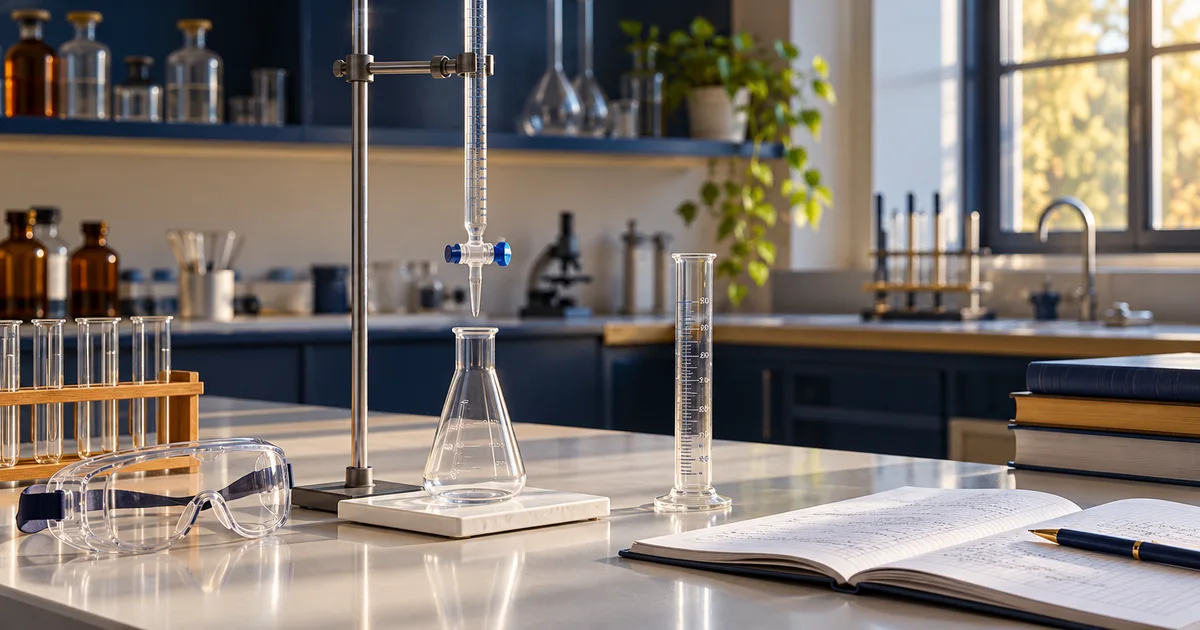
For any scale diagram, identify the unit, direction of increasing values and size of the smallest division. A burette scale increases downwards, which makes it easy to misread if you treat it like a ruler standing upright. Read the appropriate part of the meniscus at eye level when working with real apparatus, and use the precision supported by the diagram or instructions.
Suppose a burette reading changes from 1.20 cm³ to 24.65 cm³. The volume delivered is 24.65 − 1.20 = 23.45 cm³. The final reading alone is not the volume used. As a check, imagine where the liquid level began and ended: the difference represents what left the burette.
Keep observations separate from conclusions
An observation describes evidence; a conclusion interprets it. 'Bubbles appear' records something visible. Naming the gas requires appropriate evidence from a test or the context. Likewise, a precipitate is an insoluble solid formed in the mixture, so describe its appearance rather than calling every cloudy mixture a colour change.
| Practice situation | Observation | Next reasoning step |
|---|---|---|
| A reaction produces bubbles | Effervescence occurs | Use relevant evidence before naming the gas |
| A clear mixture develops a solid | A precipitate forms; record its colour | Compare with the supplied test information |
| A thermometer rises from 21 °C to 27 °C | Temperature increases by 6 °C | Consider what this suggests about energy transfer |
Calculate an average rate from results
In a practice data set, the collected gas volume increases from 18 cm³ at 20 s to 42 cm³ at 50 s. The average rate over that interval is (42 − 18)/(50 − 20) = 0.80 cm³ s⁻¹. Use the changes in both quantities; dividing 42 by 50 would describe a different interval if collection began at zero.
On a graph, mark the interval you are analysing before calculating. An average rate over an interval and the gradient of a tangent at one instant answer different questions. Keep the raw readings in your working so a subtraction or unit error is easy to find. Check whether the question asks you to describe the pattern, calculate a value or explain the chemistry behind it.
Plan an investigation that another student could follow
For a written planning exercise, imagine investigating how acid concentration affects the rate of gas production with a suitable carbonate. You need a measurement method, a clear comparison and controls. Naming concentration as the variable is only the start; explain which concentrations would be compared and what you would record. Any actual chemical work should follow your teacher's laboratory instructions.
- State the factor to change and choose a sensible range of values.
- Identify the response to measure, such as gas volume after a fixed time.
- Specify controls, such as acid volume, starting temperature and the mass and size of the solid pieces.
- Describe suitable apparatus and a consistent procedure for starting and reading the measurement.
- Include repeats, a way to compare results and precautions relevant to the materials and apparatus.
Be precise about repeats. They help reveal variation and allow you to calculate a mean, but they do not repair a leaking gas-collection system. Explain how the proposed improvement addresses the particular limitation. Avoid writing a list of apparatus without saying how the apparatus produces the result.
Use four short revision sessions
- Session 1: read scales and calculate differences, checking units at every step.
- Session 2: separate observations from conclusions in short experimental descriptions.
- Session 3: interpret a table or graph and write one complete investigation plan.
- Session 4: attempt a timed practical-skills paper, mark it and rewrite the weakest answers.
For each correction, record the reason rather than copying the entire mark scheme. Use our past-paper method to structure that review and our Chemistry revision guide for wider topic revision. If planning answers remain vague, bring one attempted answer to Chemistry tutoring so feedback can focus on the missing reasoning.
Frequently asked questions
01How long is IGCSE Chemistry Paper 6?
For Cambridge 0620 in 2026–2028, Paper 6 lasts one hour, carries 40 marks and contributes 20% of the qualification.
02Are qualitative analysis notes provided in 0620 Paper 6?
Yes. The 2026–2028 syllabus states that qualitative analysis notes are provided for Papers 5 and 6. Practise using them to interpret observations rather than assuming the table answers every question for you.
03Do I need practical understanding for Alternative to Practical?
Yes. Although you do not perform experiments during Paper 6, you need to reason about apparatus, measurements, observations and experimental design. Discuss practical methods with a teacher and use supervised laboratory opportunities where available.